Recovering from nyaope addiction among young adults
A qualitative study in Tshwane, South Africa
DOI:
https://doi.org/10.24252/al-sihah.v17i2.55249Keywords:
addiction, recovery, relapse, nyaope, young peopleAbstract
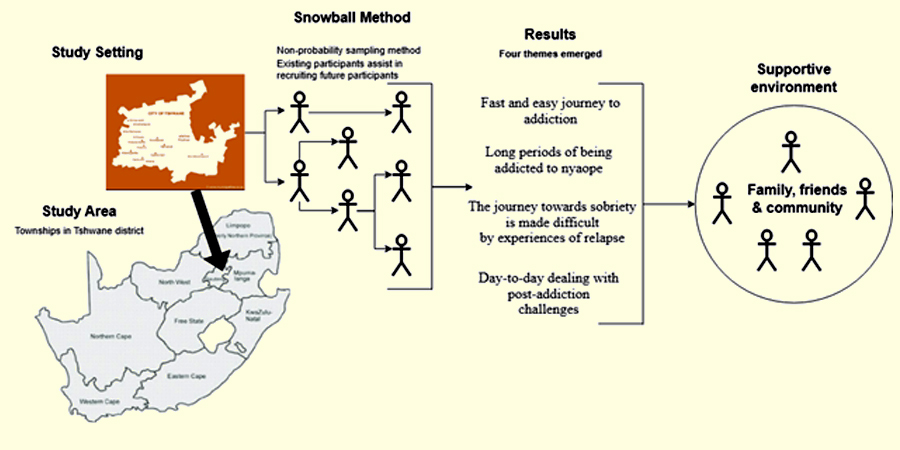
Substance abuse remains a major global health concern, with South Africa heavily impacted by nyaope use among young Black males in disadvantaged townships. Despite this, little is known about those who have successfully quit, revealing a gap in understanding recovery pathways. This qualitative phenomenological study used in-depth interviews to explore their experiences. A qualitative phenomenological study was conducted using in-depth interviews. The data were collected using the snowball method among a sample of 20 young people who managed to quit using nyaope in Tshwane, Gauteng province. NVivo was used for data analysis. The majority were single and unemployed with ages ranging from 26 to 40. About 15 (75%) in the age range 10 – 19 years started using nyaope in the adolescent phase. The number of participants who had been addicted to nyaope for over five years is 16 (80%). The longest period of being sober for two participants, 2 (10%) is over eight years. Themes identified were fast and easy journey to nyaope addiction, long periods of being addicted to nyaope, difficult journey to quitting nyaope addiction, and day-to-day dealing with post-addiction challenges of nyaope. Longer periods of addiction to nyaope were complicated by continuous relapse, which makes quitting nyaope not easy. Addiction to nyaope is complex due to its negative consequences. Therefore, recovery from nyaope addiction is a continuous, dynamic process requiring long-term support to prevent relapse. Participants highlighted the importance of a supportive environment. Recovery improves quality of life, reduces crime and violence, and strengthens social cohesion.
Downloads
References
Adler, R. H. (2022). Trustworthiness in Qualitative Research. Journal of Human Lactation, 38(4), 598–602. https://doi.org/10.1177/08903344221116620
Allsop, D., Chelladurai, J., Kimball, E., Marks, L., & Hendricks, J. (2022). Qualitative Methods with Nvivo Software: A Practical Guide for Analyzing Qualitative. Qualitative Methods with Nvivo Software: A Practical Guide for Analyzing Qualitative Data, 4(2), 142–159. https://doi.org/10.3390/psych4020013
Bala, S. and Kang’ethe, S.M., (2021). The dangers associated with female adolescents consuming Nyaope drug in Butterworth, South Africa. Journal of Human Rights and Social Work, 6(4), pp.307-317.
Best, D., & Hennessy, E. A. (2021). The science of recovery capital: where do we go from here? Addiction, 117(4). https://doi.org/10.1111/add.15732
Best, D., McKitterick, T., Beswick, T., & Savic, M. (2015). Recovery Capital and Social Networks Among People in Treatment and Among Those in Recovery in York, England. Alcoholism Treatment Quarterly, 33(3), 270–282. https://doi.org/10.1080/07347324.2015.1050931
Braun, V., & Clarke, V. (2022). Conceptual and design thinking for thematic analysis. Psycnet.apa.org, 9(1). https://doi.org/10.1037
Bruni, A. T., Henrique, C., dos Santos, C., de Castro, J., Mariotto, L. S., & Sinhorini, L. (2021). Analytical Challenges for Identification of New Psychoactive Substances: A Literature-Based Study for Seized Drugs. BrJAC Brazilian Journal of Analytical Chemistry. https://doi.org/10.30744/brjac.2179-3425.rv-41-2021
Cano, I., Best, D., Edwards, M., & Lehman, J. (2017). Recovery capital pathways: Modelling the components of recovery wellbeing. Drug and Alcohol Dependence, 181, 11–19. https://doi.org/10.1016/j.drugalcdep.2017.09.002
Cope, D. G. (2014). Methods and Meanings: Credibility and Trustworthiness of Qualitative Research. Oncology Nursing Forum, 41(1), 89–91. https://doi.org/10.1188/14.ONF.89-91
Dhakal, K. (2022). NVivo. Journal of the Medical Library Association, 110(2), 270–272. https://doi.org/10.5195/jmla.2022.1271
Dreyer, J., Pooe, J. M., Dzikiti, L., & Kruger, C. (2018). Factors associated with successful completion of a substance rehabilitation programme at a psychiatric training hospital. South African Journal of Psychiatry, 26. https://doi.org/10.4102/sajpsychiatry.v24i0.1280
Dumbili, E. W., Ebuenyi, I. D., & Ugoeze, K. C. (2021). New psychoactive substances in Nigeria: A call for more research in Africa. Emerging Trends in Drugs, Addictions, and Health, 1, 100008. https://doi.org/10.1016/j.etdah.2021.100008
Dworkin, S. L. (2012). Sample Size Policy for Qualitative Studies Using In-Depth Interviews. Archives of Sexual Behavior, 41(6), 1319–1320. https://link.springer.com/article/10.1007/s10508-012-0016-6
Fernandes, L., & Mokwena, K. (2020a). Impact of a Substance Abuse Rehabilitation Program on the Locus of Control of the Service User, a South African Study. Ashdin Publishing Journal of Drug and Alcohol Research, 9. https://doi.org/10.4303/jdar/236095
Fernandes, L., & Mokwena, K. E. (2016). The role of locus of control in nyaope addiction treatment. South African Family Practice, 58(4), 42. https://doi.org/10.4102/safp.v58i4.5445
Fernandes, L., & Mokwena, K. E. (2020b). Nyaope addiction: The despair of a lost generation. African Journal of Drug and Alcohol Studies, 19(1), 37–51. https://www.ajol.info/index.php/ajdas/article/view/203861
Gerona, R. R., & French, D. (2022). Drug testing in the era of new psychoactive substances. Advances in Clinical Chemistry, 111, 217–263. https://doi.org/10.1016/bs.acc.2022.08.001
Ghosh, P. (2013). Nyaope: Cheap drug cocktail ravaging black townships of South Africa. Global Girl Media.
Hall, F. S., & Miczek, K. A. (2019). Emerging threats in addiction: will novel psychoactive substances contribute to exacerbating the ongoing drug overdose epidemic? Psychopharmacology, 236(3), 839–843. https://doi.org/10.1007/s00213-019-05271-7
Harker, N., Londani, M., Morojele, N., Petersen Williams, P., & Parry, C. D. (2020). Characteristics and Predictors of Heavy Episodic Drinking (HED) among Young People Aged 16–25: The International Alcohol Control Study (IAC), Tshwane, South Africa. International Journal of Environmental Research and Public Health, 17(10), 3537. https://doi.org/10.3390/ijerph17103537
Kgosana, R. (2020, July 22). The nyaope isn’t worth it, but they have little else | The Citizen. The Citizen. https://www.citizen.co.za/news/south-africa/the-nyaope-isnt-worth-it-but-they-have-little-else/
Khine, A. A., Mokwena, K. E., & Moodley, V. (2018). Assessment of organ dysfunction and laboratory parameters in chronic Nyaope users. Sabinet African Journals, 32(2), pp20-24. https://journals.co.za/doi/epdf/10.10520/EJC-14676cbef4
Khine, A. A., Mokwena, K. E., Huma, M., & Fernandes, L. (2015). Identifying the composition of street drug Nyaope using two different mass spectrometer methods. African Journal of Drug and Alcohol Studies, 14(1), 49–56. https://www.ajol.info/index.php/ajdas/article/view/131003
Korstjens, I., & Moser, A. (2018). Series: Practical Guidance to Qualitative research. Part 4: Trustworthiness and Publishing. European Journal of General Practice, 24(1), 120–124. https://doi.org/10.1080/13814788.2017.1375092
Louw, Q. A., Conradie, T., Xuma-Soyizwapi, N., Davis-Ferguson, M., White, J., Stols, M., Masipa, A., Mhlabane, P., Mdaka, L., Manzini, C., Kekana, I., Schutte, M., Rabothata, S., & Kleinitz, P. (2023). Rehabilitation Capacity in South Africa—A Situational Analysis. International Journal of Environmental Research and Public Health, 20(4), 3579. https://doi.org/10.3390/ijerph20043579
Mabokela, K. E. (2018). Coverage of the consumption of nyaope in two South African tabloids : a compartive study of the Sowetan and Daily Sun Newspapers [Dissertation]. In ulspace.ul.ac.za. http://ulspace.ul.ac.za/handle/10386/2041
Mabokela, K., & Muswede, T. (2021). Framing Social Deviance: a Comparative Analysis of South African Newspapers’ Representation of Drug Use and Abuse Among The Youth. [Dissertation, African Journals OnLine]. In Gender and Behaviour (Vol. 19, Issue 1, pp. 17117–17132). http://ulspace.ul.ac.za/handle/10386/2041
Madiga, M. C., & Mokwena, K. (2022). Depression Symptoms among Family Members of Nyaope Users in the City of Tshwane, South Africa. International Journal of Environmental Research and Public Health, 19(7), 4097. https://doi.org/10.3390/ijerph19074097
Mahlangu, S., & Geyer, S. (2018). The aftercare needs of Nyaope users: implications for aftercare and reintegration services. Social Work, 54(3), 327–345. https://doi.org/10.15270/52-2-652
Masombuka, J. (2013). Children’s addiction to the drug “nyaope” in Soshanguve township: parents’ experiences and support needs [Dissertation]. In Handle.net. http://hdl.handle.net/10500/11903
Masson, E. (2022, June 6). South Africa’s longstanding drug abuse problem linked to unemployment. The Mail & Guardian. https://mg.co.za/news/2022-06-06-south-africas-longstanding-drug-abuse-problem-linked-to-unemployment/
Matuntuta, S. (2014). Is nyaope South Africa’s worst drug? News24. https://www.news24.com/life/street-drug-nyaope-classified-as-illegal-20140403
Mokwena, K. (2016). “Consider our plight”: A cry for help from nyaope users. Health SA Gesondheid, 21(1), 137–142. https://doi.org/10.1016/j.hsag.2015.09.001
Mokwena, K. E., & Huma, M. (2014). Experiences of “nyaope” users in three provinces of South Africa : substance abuse. African Journal for Physical Health Education Recreation and Dance, 20, 352–363. https://journals.co.za/doi/abs/10.10520/EJC162264#:~:text=Because%20of%20the%20intense%20cravings,regret%20for%20initiating%20nyaope%20use.
Mokwena, K., & Morojele, N. (2014). Unemployment and unfavourable social environment as contributory factors to nyaope use in three provinces of South Africa : substance abuse. Sabinet African Journals, 20(1), p374–p384. https://doi.org/10.10520
Monyakane, M. M. M. E. (2018). A rehabilitative South African criminal law response to Nyaope, drug addiction:–A recommendation for health oriented Nyaope drug weaning. Reserach in Pediatrics & Neonatology, 3(1), 206-214.
Moodley, K., & Adam, H. (2000). Race and Nation in Post-Apartheid South Africa. Current Sociology, 48(3), 51–69. https://doi.org/10.1177/0011392100048003005
Morare, M. K. (2023). An Exploration of Recovery from Nyaope Addiction Amongst Youth in Alexandra Township [Dissertation, University of the Witwatersrand, Johannesburg]. In Wits.ac.za. https://wiredspace.wits.ac.za/items/0f707694-480a-4e89-bc36-45490e588614
Morse, J. M. (2015). Critical Analysis of Strategies for Determining Rigor in Qualitative Inquiry. Qualitative Health Research, 25(9), 1212–1222. https://doi.org/10.1177/1049732315588501
Mthembi, P. M., Mwenesongole, E. M., & Cole, M. D. (2019). Chemical profiling of the street cocktail drug “nyaope” in South Africa using GC-MS II: Stability studies of the cannabinoid, opiate and antiretroviral components during sample storage. Forensic Science International, 300, 187–192. https://doi.org/10.1016/j.forsciint.2019.04.040
Mutai, K. K., Stone, J., Scheibe, A., Fraser, H., Johnson, L. F., & Vickerman, P. (2024). Trends and factors associated with illicit drug use in South Africa: Findings from multiple national population-based household surveys, 2002–2017. International Journal of Drug Policy, 125, 104352–104352. https://doi.org/10.1016/j.drugpo.2024.104352
Ndlovu, N. A., Morgan, N., Malapile, S., Subramaney, U., Daniels, W., Naidoo, J., van den Heuvel, M. P., & Calvey, T. (2021). Fronto-temporal cortical atrophy in “nyaope” combination heroin and cannabis use disorder. Drug and Alcohol Dependence, 221, 108630. https://doi.org/10.1016/j.drugalcdep.2021.108630
Nkosi, H. S. (2017). Effects of Nyaope of families with a family member that is addicted to the drug Nyaope [Dissertation]. In Wits.ac.za. https://wiredspace.wits.ac.za/items/e8eb48c4-40d6-4d97-9a26-4279f050f634
Nowell, L. S., Norris, J. M., White, D. E., & Moules, N. J. (2017). Thematic analysis: Striving to Meet the Trustworthiness Criteria. International Journal of Qualitative Methods, 16(1), 1–13. SagePub. https://doi.org/10.1177/1609406917733847
Nyakale, N., Mokwena, K., Ndlela, A. N., Zondi, N., & Nemutaduni, P. (2024). The impact of Nyaope use on brain metabolic function. Journal of Nuclear Medicine, 65(supplement 2), 242125–242125. https://jnm.snmjournals.org/content/65/supplement_2/242125
Nzaumvila, D. K., Mash, R., & Helliwell, T. (2023). Exploring the perspectives of community members on use of Nyaope in Tshwane, South Africa. South African Family Practice, 65(1), 5715. https://doi.org/10.4102/safp.v65i1.5715
O’Brien, C. (2014). The journey of recovery from addiction: a report evaluating the service provided via the secondary treatment programs of Tabor Lodge Addiction and Housing Services Limited. - Drugs and Alcohol [Thesis]. In Drugsandalcohol.ie. https://www.drugsandalcohol.ie/23435/1/CarmelOBrien.pdf
Pengpid, S., Peltzer, K., & Ramlagan, S. (2021). Prevalence and correlates of hazardous, harmful or dependent alcohol use and drug use amongst persons 15 years and older in South Africa: Results of a national survey in 2017. African Journal of Primary Health Care & Family Medicine, 13(1). https://doi.org/10.4102/phcfm.v13i1.2847
Polit, D. F., & Beck, C. T. (2010). Essentials of Nursing Research: Appraising Evidence for Nursing Practice. In Google Books. Lippincott Williams & Wilkins. https://books.google.co.za/books?id=7GtP8VCw4BYC&printsec=frontcover&source=gbs_ge_summary_r&cad=0#v=onepage&q&f=false
Pratt, J. M., & Yezierski, E. J. (2018). A novel qualitative method to improve access, elicitation, and sample diversification for enhanced transferability applied to studying chemistry outreach. Chemistry Education Research and Practice, 19(2), 410–430. https://doi.org/10.1039/c7rp00200a
Sadike, M. (2023, May 22). I’ve had enough and want to be sober, says nyaope addict. Iol.co.za. https://www.iol.co.za/pretoria-news/news/ive-had-enough-and-want-to-be-sober-says-nyaope-addict-2d6f265a-8741-440a-9a04-14dadc4fbe4e
Scheibe, A., Ncube, L., Nonyane, D., Coetzee-Spies, M., & Marcus, T. (2023). Community Oriented Substance Use Programme in the City of Tshwane: A Cross-sectional Survey of Stakeholder Perceptions. Southern African Journal of Social Work and Social Development, 35(3). https://doi.org/10.25159/2708-9355/13358
Smith, J. A., Larkin, M., & Flowers, P. (2021). Interpretative phenomenological analysis: Theory, method and research.
Statistics South Africa. (2023). Quarterly Labour Force Survey (QLFS). Statssa.gov.za; Statistics South Africa. https://www.statssa.gov.za/?page_id=16408
Stokes, M., Schultz, P., & Alpaslan, A. (2018). Narrating the journey of sustained recovery from substance use disorder. Substance Abuse Treatment, Prevention, and Policy, 13(1). https://doi.org/10.1186/s13011-018-0167-0
Strauss, L. (2022). Nyaope and anaesthesia. Southern African Journal of Anaesthesia and Analgesia, S150–S155. https://www.sajaa.co.za/index.php/sajaa/article/view/2892
Tetarwal, A., Yengopal, V., Munshi, I., & Meel, R. (2019). Oral health status among Nyaope users at drug rehabilitation clinics in Johannesburg. South African Dental Journal, 74(1). https://doi.org/10.17159/2519-0105/2019/v74no1a2
Tewolde, A. I. (2024). Self-identification in post-Apartheid South Africa: The case of Coloured people in Johannesburg, South Africa. Social Sciences & Humanities Open, 9, 100866–100866. https://doi.org/10.1016/j.ssaho.2024.100866
Tuwani, T. (2013). Giving up nyaope is hard; relapse is easy. The Daily News.
United Nations. (2023). UN DESA. 2023. The Sustainable Development Goals Report 2023: Special Edition - July 2023. New York, USA: UN DESA. © UN DESA. https://unstats.un.org/sdgs/report/2023/
United Nations. (2024). World Drug Report 2024. In United Nations. United Nations. https://www.unodc.org/unodc/en/data-and-analysis/world-drug-report-2024.html
Varshney, K., Browning, S. D., Debnath, S. K., Shet, P., & Shet, D. (2022). A Systematic Review of Risk Factors and Consequences of Nyaope Usage: The Illicit Street Drug Containing HIV Antiretrovirals. National Library of Medicine, 27(2). https://doi.org/10.1007/s10461-022-03791-6
Vasileiou, K., Barnett, J., Thorpe, S., & Young, T. (2018). Characterising and Justifying Sample Size Sufficiency in interview-based studies: Systematic Analysis of Qualitative Health Research over a 15-year Period. BMC Medical Research Methodology, 18(1), 1–18. https://doi.org/10.1186/s12874-018-0594-7
Wallengren, E., Guthold, R., Newby, H., Moller, A. B., Marsh, A. D., Fagan, L., & Kågesten, A. E. (2024). Relevance of the sustainable development goals (SDGs) to adolescent health measurement: A systematic mapping of the SDG Framework and global adolescent health indicators. Journal of Adolescent Health, 74(6), S47-S55.
Wood, L., Sebar, B., & Vecchio, N. (2020). Application of Rigour and Credibility in Qualitative Document Analysis: Lessons Learnt from a Case Study. The Qualitative Report, 25(2). https://doi.org/10.46743/2160-3715/2020.4240
Published
How to Cite
Issue
Section
License
Copyright (c) 2025 Mmampedi Mathibe, Kebogile Mokwena

This work is licensed under a Creative Commons Attribution-NonCommercial-ShareAlike 4.0 International License.
Authors retain copyright and grant the journal right of first publication with the work simultaneously licensed under a Creative Commons Attribution-NonCommercial-ShareAlike 4.0 International License that allows others to share the work with an acknowledgment of the work's authorship and initial publication in this journal.
Authors are able to enter into separate, additional contractual arrangements for the non-exclusive distribution of the journal's published version of the work (e.g., post it to an institutional repository or publish it in a book), with an acknowledgment of its initial publication in this journal.
Authors are permitted to publish their work online in third parties as it can lead to wider dissemination of the work.