Hypertension as a social and spiritual experience
A qualitative study in Paccellekang Village, Indonesia
DOI:
https://doi.org/10.24252/al-sihah.v17i2.57245Keywords:
experience, hypertension, rural, social, spiritualityAbstract
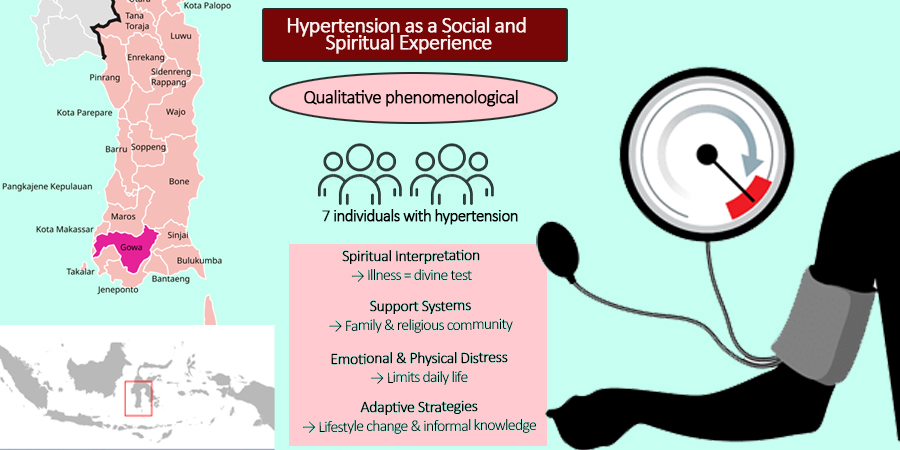
Although hypertension is widely addressed in clinical literature, limited attention has been given to its social and spiritual dimensions, particularly in rural settings. This study explores the lived experiences of individuals with hypertension in Paccellekang Village, South Sulawesi, Indonesia, aiming to understand how they perceive and cope with the condition. A qualitative phenomenological design was employed, involving in-depth interviews with seven hypertensive participants from March to May 2025. Thematic analysis using Colaizzi’s method revealed four main themes: personal experience of emotional distress and physical limitation; the meaning of hypertension as both an illness and a divine test; the role of spirituality and family support in managing the condition; and adaptive strategies involving lifestyle changes and informal health knowledge. These highlight that hypertension is perceived as a multidimensional experience shaped by culture, beliefs, and social relationships. The study emphasizes the need for culturally sensitive and spiritually integrated interventions in rural communities to improve adherence and promote holistic well-being. This contributes directly to strengthening primary healthcare initiatives in rural Indonesia. The study concludes that effective hypertension care in rural communities must consider these social and spiritual dimensions. It is recommended that health education programs integrate religious values and community-based support to strengthen treatment adherence and improve patient well-being.
Downloads
References
Abdel-Khalek, A. M., & Lester, D. (2021). The association between religiosity, health, and well-being in a cross-cultural perspective. Mental Health, Religion & Culture, 24(3), 218–230.
Afiyanti, Y., & Rachmawati, I. N. (2019). Phenomenological approaches in Indonesian nursing research: Lessons and applications. Journal of Nursing Research, 27(2), e12.
Creswell, J. H., & Poth, C. N. (2018). Qualitative inquiry & research design: Choosing among five approaches (5th ed.). Sage Publications.
Kagawa-Singer, M., & Blackhall, L. J. (2001). Negotiating cross-cultural issues at the end of life: “You got to go where he lives.” JAMA, 286(23), 2993–3001.
Kementerian Kesehatan Republik Indonesia. (2016). Pedoman umum Program Indonesia Sehat dengan Pendekatan Keluarga (PIS-PK). Jakarta: Kementerian Kesehatan Republik Indonesia.
Kementerian Kesehatan Republik Indonesia. (2017). Gerakan Masyarakat Hidup Sehat (Germas): Panduan implementasi di tingkat daerah. Jakarta: Kementerian Kesehatan Republik Indonesia.
Kementerian Kesehatan Republik Indonesia. (2021). Pedoman penanggulangan penyakit tidak menular di Puskesmas. Direktorat P2PTM, Ditjen Pencegahan dan Pengendalian Penyakit, Jakarta: Kementerian Kesehatan Republik Indonesia.
Kementerian Kesehatan RI. (2024). Laporan tematik survei kesehatan Indonesia tahun 2023. http://scioteca.caf.com/bitstream/handle/123456789/1091/RED2017-Eng-8ene.pdf?sequence=12&isAllowed=y
Kleinman, A. (1988). The illness narratives: Suffering, healing, and the human condition. Basic Books.
Koenig, H. G. (2020). Religion, spirituality, and health: A review and update. Advances in Mind-Body Medicine, 34(1), 18–26.
Kretchy, I. A., Asiedu-Danso, M., & Kretchy, J. P. (2021). Medication adherence and self-care behaviours among patients with hypertension in Ghana. International Journal of Hypertension, 2021, 1–9.
Lim, S. S., Vos, T., Flaxman, A. D., Danaei, G., Shibuya, K., Adair-Rohani, H., … Ezzati, M. (2020). A comparative risk assessment of hypertension-related global burden of disease. The Lancet, 396(10258), 109–123.
Lincoln, Y. S., & Guba, E. G. (1985). Naturalistic inquiry. Sage Publications.
Mendoza-Núñez, V. M., et al. (2021). Spiritual well-being and hypertension management: A qualitative synthesis. BMC Public Health, 21(1), 2145. https://doi.org/10.1186/s12889-021-12173-2
Mills, K. T., Stefanescu, A., & He, J. (2020). The global epidemiology of hypertension. Nature Reviews Nephrology, 16(4), 223–237. https://doi.org/10.1038/s41581-019-0244-2
Nguyen, T. L., & Do, H. T. (2021). Understanding chronic disease experiences in Vietnam: A phenomenological perspective. Asian Journal of Qualitative Research, 4(2), 77–89.
Nowell, L. S., Norris, J. M., White, D. E., & Moules, N. J. (2017). Thematic analysis: Striving to meet the trustworthiness criteria. International Journal of Qualitative Methods, 16(1), 1–13. https://doi.org/10.1177/1609406917733847
Oliveros, E., Patel, H., Kyung, S., Fugar, S., Williams, K. A., & Narayan, P. (2020). Hypertension in older adults: An overview of the current evidence. Current Hypertension Reports, 22(7), 45. https://doi.org/10.1007/s11906-020-01067-0
Polit, D. F., & Beck, C. T. (2012). Nursing research: Generating and assessing evidence for nursing practice (9th ed.). Lippincott Williams & Wilkins.
Rahman, N., Subagyo, A., & Ismail, R. (2023). Phenomenological exploration of spiritual coping among hypertensive patients in Southeast Asia. International Journal of Qualitative Health Studies, 8(1), 45–55.
Risnah, & Muhammad Irwan. (2023). Teori dan model keperawatan. CV Trans Info Media.
Sari, D. P., Handayani, S., & Yulianti, A. (2020). Exploring the lived experience of patients with chronic illness: A qualitative study in Indonesia. Belitung Nursing Journal, 6(5), 168–175. https://doi.org/10.33546/bnj.1148
Sugiyono. (2017). Metode penelitian kuantitatif, kualitatif dan R&D. Penerbit Alfabeta.
Sukfitrianty, S., Aswadi, A., & Lagu, A. M. H. (2016). Faktor risiko hipertensi pada ibu hamil di Rumah Sakit Hikmah Kota Makassar. Al-Sihah: The Public Health Science Journal.
Tadesse, D. B., Alemayehu, M., & Tilahun, T. (2022). Gender differences in the management of hypertension in rural communities. Journal of Health, Population and Nutrition, 41(1), 1–9.
United Nations. (2015). Transforming our world: the 2030 Agenda for Sustainable Development (A/RES/70/1). United Nations General Assembly
Xi, Y., Xu, Y., & Wang, Y. (2020). Too-much-of-a-good-thing effect of external resource investment—A study on the moderating effect of psychological capital on the contribution of social support to work engagement. International journal of environmental research and public health, 17(2), 437. https://doi.org/10.3390/ijerph17020437
Xie, Z., Liu, K., Or, C., Chen, J., Yan, M., & Wang, H. (2020). An examination of the socio-demographic correlates of patient adherence to self-management behaviors and the mediating roles of health attitudes and self-efficacy among patients with coexisting type 2 diabetes and hypertension. BMC public health, 20(1), 1227. https://doi.org/10.1186/s12889-020-09274-4
Published
How to Cite
Issue
Section
License
Copyright (c) 2025 Harmawati Harmawati, Aslinda Aslinda, Nadeeya 'Ayn Umaisara Binti Mohamad Nor , Risnah Risnah, Rasmawati Rasmawati, Muhammad Irwan

This work is licensed under a Creative Commons Attribution-NonCommercial-ShareAlike 4.0 International License.
Authors retain copyright and grant the journal right of first publication with the work simultaneously licensed under a Creative Commons Attribution-NonCommercial-ShareAlike 4.0 International License that allows others to share the work with an acknowledgment of the work's authorship and initial publication in this journal.
Authors are able to enter into separate, additional contractual arrangements for the non-exclusive distribution of the journal's published version of the work (e.g., post it to an institutional repository or publish it in a book), with an acknowledgment of its initial publication in this journal.
Authors are permitted to publish their work online in third parties as it can lead to wider dissemination of the work.