Maternal knowledge and caregiver attitudes toward accurate complementary feeding according to WHO recommendations
A study at Riau, Indonesia
DOI:
https://doi.org/10.24252/al-sihah.v17i2.61219Keywords:
attitude, breastfeeding, caregiver, complementary feeding, knowledgeAbstract
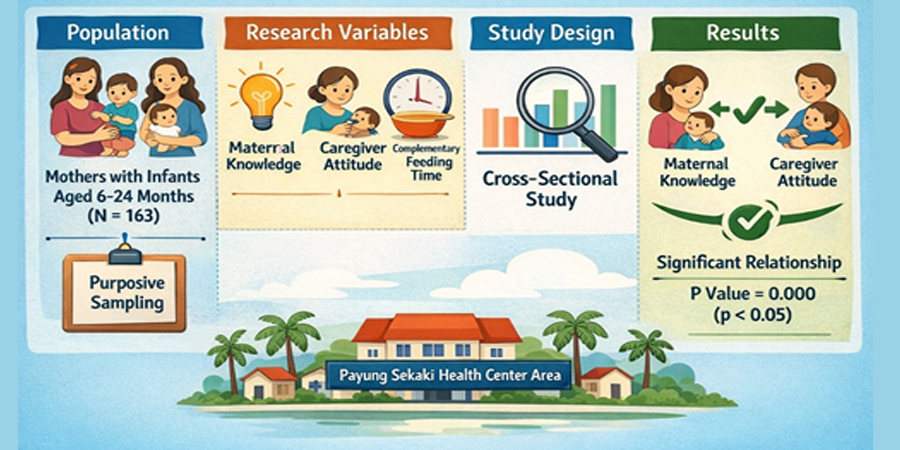
The percentage of exclusive breastfeeding in Pekanbaru City in 2022 decreased compared to the previous year, thus putting babies at risk of receiving complementary foods too early, which has short-term and long-term impacts. Short-term negative impacts include babies losing nutrients from breast milk, triggering diarrhea, anemia, and reducing the baby's sucking ability. While long-term negative impacts include obesity, hypertension, allergies, and atherosclerosis. The purpose of this study was to determine the relationship between maternal knowledge and caregivers' attitudes towards providing complementary foods (MP-ASI) in the Payung Sekaki Community Health Center Work Area, Pekanbaru City, Riau. This study used a cross-sectional design, conducted from December 2023 to July 2024 in the Payung Sekaki Community Health Center Work Area, Pekanbaru City, Riau. The sample in this study were 163 mothers with babies aged 6-24 months with a sampling technique using purposive sampling. The instrument in this study was a questionnaire. The data analysis technique used univariate and bivariate analysis with Chi Square statistical test in SPSS 26. There was a relationship between maternal knowledge and caregiver attitudes towards providing complementary feeding in the Payung Sekaki Community Health Center Working Area with a p value = 0.000 (p <0.05). The better the mother's knowledge about complementary feeding, the more likely a mother will provide complementary feeding on time and respondents who have a positive attitude tend to provide complementary feeding on time.
Downloads
References
Abeshu, M. A., Adish, A., Haki, G. D., Lelisa, A., & Geleta, B. (2016a). Assessment of Caregiver’s Knowledge, Complementary Feeding Practices, and Adequacy of Nutrient Intake from Homemade Foods for Children of 6–23 Months in Food Insecure Woredas of Wolayita Zone, Ethiopia. Frontiers in Nutrition, 3(August), 1–12. https://doi.org/10.3389/fnut.2016.00032
Abeshu, M. A., Lelisa, A., & Geleta, B. (2016b). Complementary Feeding: Review of Recommendations, Feeding Practices, and Adequacy of Homemade Complementary Food Preparations in Developing Countries – Lessons from Ethiopia. Frontiers in Nutrition, 3(October). https://doi.org/10.3389/fnut.2016.00041
Abiyu, C., & Belachew, T. (2020). Effect of complementary feeding behavior change communication delivered through community-level actors on dietary adequacy of infants in rural communities of West Gojjam Zone, Northwest Ethiopia: A cluster-randomized controlled trial. PLOS ONE, 15(8), 1–19. https://doi.org/10.1371/journal.pone.0238355
Aga, J. A., Naupal-Forcadilla, R. T., & Cayetano, C. (2024). Caregivers’ knowledge, attitude, and practices on complementary feeding of young children aged 6–23 months in Naga City, Philippines. Journal of Health Education and Society, 1(1), 1–16. https://doi.org/10.56237/jhes23004
Ali, M., Arif, M., & Shah, A. A. (2021). Complementary feeding practices and associated factors among children aged 6-23 months in Pakistan. PLoS ONE, 16(2 February), 1–21. https://doi.org/10.1371/journal.pone.0247602
Alvisi, P., Brusa, S., Alboresi, S., Amarri, S., Bottau, P., Cavagni, G., Corradini, B., Landi, L., Loroni, L., Marani, M., Osti, I. M., Povesi-Dascola, C., Caffarelli, C., Valeriani, L., & Agostoni, C. (2015). Recommendations on complementary feeding for healthy, full-term infants. Italian Journal of Pediatrics, 41, 1–9. https://doi.org/10.1186/s13052-015-0143-5
Anak Usia 6-24 Bulan Tentang Mpasi dengan Perilaku Pemberian Mpasi (Studi di Desa Purwosari Kecamatan Kwadungan Kabupaten Ngawi). E-Journal Cakra Medika, 9(2), 19–27. https://doi.org/10.55313/ojs.v9i2.113
Anggraeni, R., Aljaberi, M. A. A., Nisha Nambiar, N., Sansuwito, T. Bin, & Wati, N. L. (2022). The Relationship of Supplementary Feeding, Breast Milk (MP-ASI) to Infants with The Event of Diarrhea. International Journal of Nursing Information, 1(1), 1–9. https://doi.org/10.58418/ijni.v1i1.9
Aristawati, T. V. (2021). Hubungan Pemberian MP-ASI Dini, Waktu, Jenis dan Cara Pemberian MP-ASI dengan Kejadian Diare pada Bayi 6 - 8 Bulan di Wilayah Kerja PUskesmas Lingkar TImur Kota Bengkulu. In Politeknik Kesehatan Kemenkes Bengkulu.
Arlis, I. (2024). Pengaruh Pendidikan Kesehatan Melalui Media Video Tentang MP-ASI Terhadap Pengetahan Ibu Balita di Kecamatan Rengat Tahun 2023. 4, 8630–8638.
Azizah, U., Aisyah, S., Silaban, T. D. S., & Ismed, S. (2022). Hubungan Pengetahuan, Sikap, dan Dukungan Keluarga Terhadap Ketepatan Pemberian MP-ASI Di Wilayah Kerja Puskesmas Pematang Panggang II Tahun 2022. IMJ (Indonesian Midwifery Journal), 5(2), 22. https://doi.org/10.31000/imj.v5i2.6913
Bergamini, M., Simeone, G., Verga, M. C., Doria, M., Cuomo, B., Antonio, G. D., Iacono, I. Dello, Mauro, G. Di, Leonardi, L., & Miniello, V. L. (2022). Diseases: A Systematic Review and Meta-Analysis. 1–20.
Boswell, N. (2021). Complementary feeding methods — A review of the benefits and risks. Nutrition and Health, 27(2), 1–12. https://doi.org/10.1177/02601060211018732
Darmawan, F. H., & Sinta, E. N. M. (2015). Hubungan Pengetahuan dan Sikap Ibu dengan Perilaku Pemberian MP-ASI yang Tepat pada Bayi Usia 6-12 Bulan di Desa Sekarwangi Kabupaten Sumedang. Jurnal Bidan “Midwife Journal,” 1(2), 32–42.
Demirel, Y., Id, O., Id, I. C., & Bilgin, A. S. (2025). Factors affecting behaviors during complementary feeding in infants. PLOS ONE, 20(12), 1–16. https://doi.org/10.1371/journal.pone.0314694
Dinas Kesehatan Provinsi Riau. (2022). Profil Kesehatan Provinsi Riau Tahun 2022.
Eka Fitri, N. (2022). Hubungan Pengetahuan Ibu Dengan Pemberian Mp-Asi Dini Pada Bayi 0-6 Bulan Di Desa Parjalihotan Pinangsori Tahun 2021.
Ekasari, T. (2018). Pengaruh Dukungan Keluarga Terhadap Pemberian Makanan Pendamping Asi (Mp-Asi) Pada Bayi Usia Kurang Dari 6 Bulan. JI-KES (Jurnal Ilmu Kesehatan), 1(2), 62–66. https://doi.org/10.33006/ji-kes.v1i2.82
Published
How to Cite
Issue
Section
License
Copyright (c) 2025 Dewi Sartika Siagian, Siti Khuzaiyah, Rini Hariani Ratih, Imelda Fitri, Nasri Devi

This work is licensed under a Creative Commons Attribution-NonCommercial-ShareAlike 4.0 International License.
Authors retain copyright and grant the journal right of first publication with the work simultaneously licensed under a Creative Commons Attribution-NonCommercial-ShareAlike 4.0 International License that allows others to share the work with an acknowledgment of the work's authorship and initial publication in this journal.
Authors are able to enter into separate, additional contractual arrangements for the non-exclusive distribution of the journal's published version of the work (e.g., post it to an institutional repository or publish it in a book), with an acknowledgment of its initial publication in this journal.
Authors are permitted to publish their work online in third parties as it can lead to wider dissemination of the work.