
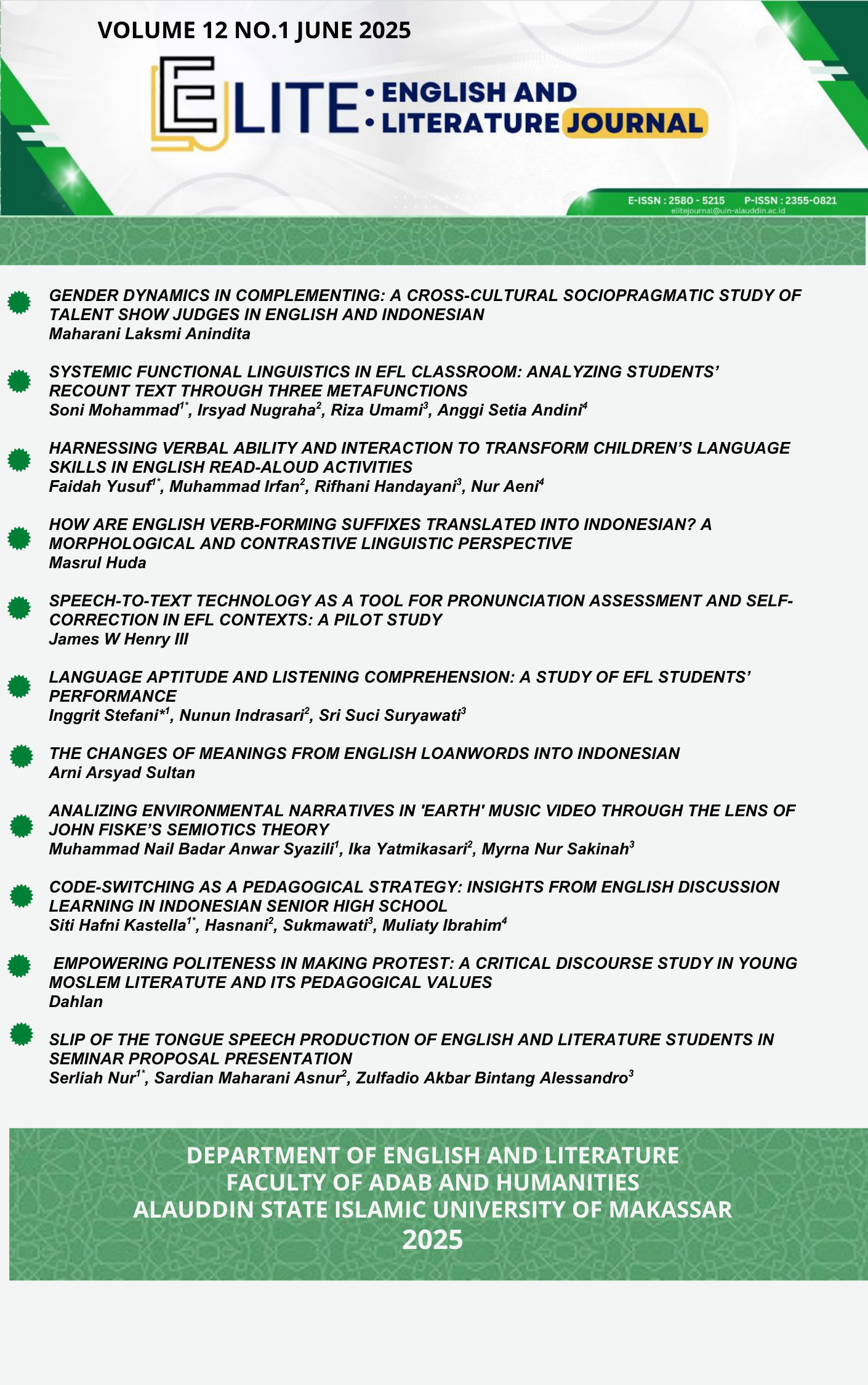
SPEECH-TO-TEXT TECHNOLOGY AS A TOOL FOR PRONUNCIATION ASSESSMENT AND SELF-CORRECTION IN EFL CONTEXTS: A PILOT STUDY
Kata Kunci:
Teknologi pengenalan suara, penilaian pengucapan bahasa Inggris, Computer-Assisted Language Learning (CALL), umpan balik pengucapan, pengajaran EFLAbstrak
Studi percontohan ini meneliti keefektifan teknologi speech-to-text (STT) sebagai mekanisme umpan balik objektif untuk penilaian pengucapan dan koreksi diri dalam kelas Bahasa Inggris sebagai Bahasa Asing (EFL). Penelitian ini melibatkan 75 mahasiswa universitas Jepang dari tiga kelas yang berinteraksi dengan aplikasi STT selama dua sesi 25 menit dalam satu semester. Data yang dikumpulkan mencakup tingkat keberhasilan transkripsi, peningkatan fitur pengucapan spesifik, dan respon afektif siswa. Hasil menunjukkan bahwa perangkat lunak STT memberikan umpan balik objektif dan langsung yang melengkapi metode pengajaran pengucapan tradisional, dengan siswa menunjukkan peningkatan terukur dalam tingkat keberhasilan transkripsi (dari 38% menjadi 62%) dan melaporkan peningkatan kepercayaan diri dalam kemampuan berbicara mereka. Studi percontohan ini berkontribusi pada bidang Computer-Assisted Language Learning (CALL) yang berkembang dengan menawarkan pendekatan praktis dan mudah diakses untuk umpan balik pengucapan yang dapat diimplementasikan dengan persyaratan teknologi dan investasi waktu minimal.
Unduhan
Referensi
Aoyama, K., Flege, J. E., Guion, S. G., Akahane-Yamada, R., & Yamada, T. (2004). Perceived phonetic dissimilarity and L2 speech learning: The case of Japanese /r/ and English /l/ and /r/. Journal of Phonetics, 32(2), 233-250.
Baker, A., & Burri, M. (2016). Feedback on second language pronunciation: A case study of EAP teachers' beliefs and practices. Australian Journal of Teacher Education, 41(6), 1-19.
Bradlow, A. R., Akahane-Yamada, R., Pisoni, D. B., & Tohkura, Y. (2001). Training Japanese listeners to identify English /r/ and /l/: Long-term retention of learning in perception and production. Perception & Psychophysics, 61(5), 977-985.
Celce-Murcia, M., Brinton, D. M., & Goodwin, J. M. (2010). Teaching pronunciation: A course book and reference guide (2nd ed.). Cambridge University Press.
Dörnyei, Z. (2007). Research methods in applied linguistics. Oxford University Press.
Dörnyei, Z. (2009). The L2 motivational self system. In Z. Dörnyei & E. Ushioda (Eds.), Motivation, language identity and the L2 self (pp. 9-42). Multilingual Matters.
Evers, K., & Chen, S. (2022). Effects of an automatic speech recognition system with peer feedback on pronunciation instruction for adults. Computer Assisted Language Learning, 35(10), 1869-1889.
Inceoglu, S., Chen, W. H., & Lim, H. (2023). Assessment of L2 intelligibility: Comparing L1 listeners and automatic speech recognition. ReCALL, 35(1), 89-104.
John, P., Johnson, C., & Cardoso, W. (2025). Exploring automatic speech recognition for corrective and confirmative pronunciation feedback. Journal of Second Language Pronunciation.
Kartchava, E., & Ammar, A. (2014). The noticeability and effectiveness of corrective feedback in relation to target type. Language Teaching Research, 18(4), 428-452.
Lee, J., Jang, J., & Plonsky, L. (2015). The effectiveness of second language pronunciation instruction: A meta-analysis. Applied Linguistics, 36(3), 345-366.
Levis, J. M. (2007). Computer technology in teaching and researching pronunciation. Annual Review of Applied Linguistics, 27, 184-202.
Levis, J. M. (2018). Intelligibility, oral communication, and the teaching of pronunciation. Cambridge University Press.
Liu, Y., Rahman, F. A., & Zain, F. M. (2025). A systematic literature review of research on automatic speech recognition in EFL pronunciation. Cogent Education, 12(1).
Lyster, R., & Saito, K. (2010). Oral feedback in classroom SLA: A meta-analysis. Studies in Second Language Acquisition, 32(2), 265-302.
McCrocklin, S. M. (2016). Pronunciation learner autonomy: The potential of automatic speech recognition. System, 57, 25-42.
McCrocklin, S. M. (2019). ASR-based dictation practice for second language pronunciation improvement. Journal of Second Language Pronunciation, 5(1), 98-118.
Mroz, A. (2018). Seeing how people hear you: French learners experiencing intelligibility through automatic speech recognition. Foreign Language Annals, 51(3), 617-637.
Munro, M. J., & Derwing, T. M. (2015). A prospectus for pronunciation research in the 21st century: A point of view. Journal of Second Language Pronunciation, 1(1), 11-42.
Neri, A., Cucchiarini, C., & Strik, H. (2008). The effectiveness of computer-based speech corrective feedback for improving segmental quality in L2 Dutch. ReCALL, 20(2), 225-243.
O'Brien, M. G., Derwing, T. M., Cucchiarini, C., Hardison, D. M., Mixdorff, H., Thomson, R. I., Strik, H., Levis, J. M., Munro, M. J., Foote, J. A., & Levis, G. M. (2018). Directions for the future of technology in pronunciation research and teaching. Journal of Second Language Pronunciation, 4(2), 182-207.
Rogti, M. (2025). Automatic pronunciation evaluation feedback and peer correction for shaping English pronunciation accuracy and interpersonal communication. Innovation in Language Learning and Teaching, 1-17.
Sardegna, V. G. (2011). Pronunciation learning strategies that improve ESL learners' linking. In J. Levis & K. LeVelle (Eds.), Proceedings of the 2nd Pronunciation in Second Language Learning and Teaching Conference (pp. 105-121). Iowa State University.
Sun, C. (2023). The impact of automatic speech recognition technology on second language pronunciation and speaking skills of EFL learners: A mixed methods investigation. Frontiers in Psychology.
Thomson, R. I., & Derwing, T. M. (2015). The effectiveness of L2 pronunciation instruction: A narrative review. Applied Linguistics, 36(3), 326-344.
Ueyama, M. (2000). Prosodic transfer: An acoustic study of L2 English vs. L2 Japanese. University of California, Los Angeles.
Wallace, L. (2016). Using Google Web Speech as a springboard for identifying personal pronunciation problems. Proceedings of the 7th Pronunciation in Second Language Learning and Teaching Conference, 180-186.
Xiao, Y. (2025). The impact of AI-driven speech recognition on EFL listening comprehension, flow experience, and anxiety: A randomized controlled trial. Humanities and Social Sciences Communications, 12(1), 425.
Unduhan
Diterbitkan
Cara Mengutip
Terbitan
Bagian
Lisensi
Hak Cipta (c) 2025 James Henry

Artikel ini berlisensiCreative Commons Attribution-NonCommercial-ShareAlike 4.0 International License.
Once an article was published in the journal, the author(s) are:
granted to the journal right licensed under Creative Commons License Attribution that allows others to share the work with an acknowledgement of the work's authorship.
permitted to publish their work online in third parties as it can lead wider dissemination of the work.
continue to be the copyright owner and allow the journal to publish the article with the CC BY-NC-SA 4.0 license
receiving a DOI (Digital Object Identifier) of the work.