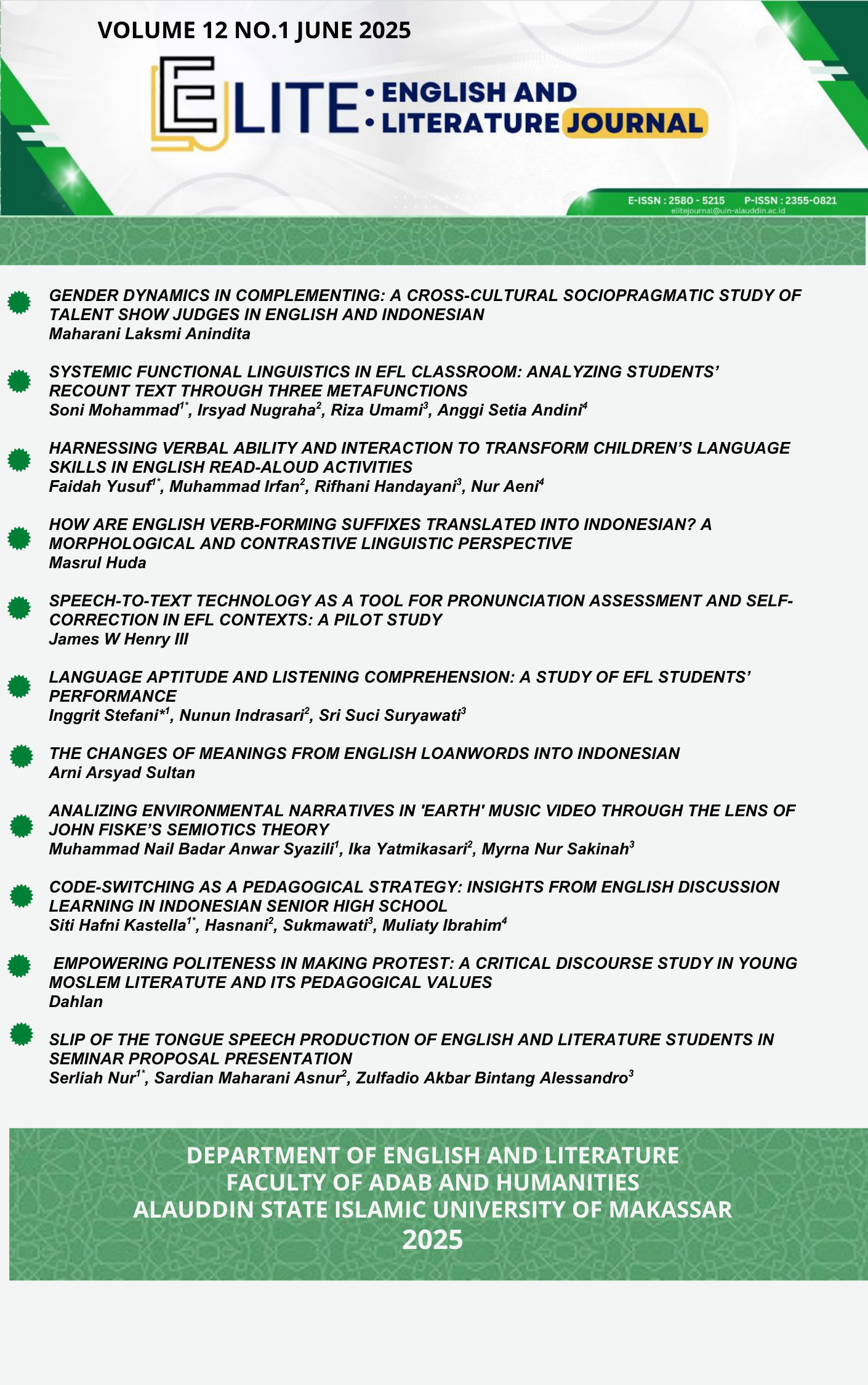
Dinamika Gender dalam Pujian: Studi Sosiopragmatik Lintas Budaya pada Juri Ajang Pencarian Bakat dalam Bahasa Inggris dan Indonesia
Kata Kunci:
Inggris, Indonesia, gender, pujianAbstrak
Setiap bahasa dapat menjadi cerminan dari kondisi sosial suatu masyarakat yang berbeda, termasuk perbedaan sosial yang ada pada gender dimana perempuan dan laki-laki memiliki norma penggunaan Bahasa yang berbeda. Tiap-iap Bahasa juga memiliki normanya masing-masing. Salah satu perbedaan tersebut ada pada perbedaan penggunaan pujian. Penelitian ini termasuk dalam penelitian kualitatif deskriptif-komparatif dan bertujuan untuk memahami strategi dan fungsi dari pujian yang digunakan berdasarkan gender dalam bahasa Inggris dan Indonesia dalam acara America’s dan Indonesia’s Got Talent 2023. Hasil penelitian ini menunjukan bahwa dalam Bahasa Inggris, perempuan lebih mendominasi dalam memberikan pujian, sementara dalam Bahasa Indonesia jumlahnya seimbang antara perempuan dan laki-laki. Mengenai strategi, ada perbedaan dalam penggunaan strategi pujian tidak langsung, dimana dalam bahasa Inggris digunakan merata pada kedua gender, sementara dalam bahasa Indonesia hanya digunakan oleh gender perempuan dalam jumlah sangat sedikit. Fungsi pujian dalam kedua bahasa lebih banyak menunjukan kesamaan dan hanya berbeda pada satu fungsi saja, yaitu fungsi memperhalus FTA.
Unduhan
Referensi
Åberg, E., Koivula, A., Kukkonen, I., Sarpila, O., & Pajunen, T. (2020). Compliment rules or compliments rule? a population-level study of appearance commenting norms on social media. Springer Nature Switzerland AG, 12195 LNCS, 16–28. https://doi.org/10.1007/978-3-030-49576-3_2
Al-Shboul, Y., Huwari, I. F., Al-Dala’ien, O. A., & Al-Daher, Z. (2022). An Analysis of Compliment Response Strategies by Jordanian Adolescent Students: The Influence of Gender and Social Power. Theory and Practice in Language Studies, 12(7), 1252–1261. https://doi.org/10.17507/tpls.1207.02
Alosaimi, R. S., & Alenizi, D. A. M. (2024). Unraveling Gender-related differences in Compliment exchanges: the case of Hijazi Speakers. Register Journal, 17(1), 189–224. https://doi.org/10.18326/register.v17i1.189-224
Bibi, F., & Sartini, N. W. (2023). “Gender and social power dynamics in compliment responses: A cross-cultural pragmatic study of university students in Indonesia and Pakistan.” Cogent Arts and Humanities, 10(1), 1–18. https://doi.org/10.1080/23311983.2023.2262076
Brown, P., & Levinson, S. C. (1978). Universals in language usage: Politeness phenomena. In Questions and politeness: Strategies in social interaction (pp. 56–311). Cambridge University Press.
Fortunasari, Adrefiza, & Febriani, N. (2019). GENDER-BASED ANALYSIS IN GIVING COMPLIMENT BY EFL STUDENTS. English Language Teaching Journal, 4(1), 16–29. https://online-journal.unja.ac.id/jelt/index
Hanifah, P. A., & Marlina, L. (2022). Gender-Based Compliments Used by Judges in America’s Got Talent 2019. English Language and Literature, 11(3), 298. https://doi.org/10.24036/ell.v11i3.118532
Haugh, M., Kádár, D. Z., & Terkourafi, M. (2021). Introduction: directions in sociopragmatics. In The Cambridge Handbook of Sociopragmatics (pp. 1–12). Cambridge University Press. https://doi.org/10.1017/9781108954105.001
Herbert, R. K. (1989). The ethnography of English compliments and compliment responses: A contrastive sketch. Pragmatics and Beyond, 1(3), 3–35. https://doi.org/https://doi. org/10.1075/pbns.3.05her
Herbert, R. K. (1990). Sex-based differences in compliment behavior. Language in Society, 19(2), 201–224. https://doi.org/10.1017/S0047404500014378
Holmes, J. (1988). PAYING COMPLIMENTS: A SEX-PREFERENTIAL POLITENESS STRATEGY. Journal of Pragmatics, 12(4), 445–465. https://doi.org/https://doi.org/10.1016/0378-2166(88)90005-7
Jaworski, A. (1995). “This is not an empty compliment!” Polish compliments and the expression of solidarity. International Journal of Applied Linguistics, 5(1), 63–94. https://doi.org/https://doi.org/10.1111/j.1473-4192.1995.tb00073.x
Lakoff, R. H. (1975). Language and woman’s place. Harper & Row.
Leech, G. N. (1983). Principles of Pragmatics. In Computation of Language. Longman Group Limited. https://doi.org/10.1007/978-3-642-74564-5_12
Mahsun, M. S. (2008). Penelitian Bahasa Berbagai Tahapan Strategi Metode dan Teknik-Tekniknya. Mataram University Press.
Manes, J., & Wolfson, N. (1981). The compliment formula. Conversational Routine: Explorations in Standardized Communication Situations and Prepatterned Speech, 96, 115–132. https://doi.org/https://doi.org/10.2307/3877403
Masmoudi, I., & Jarrar, A. (2022). Compliment Responses across Gender: Moroccan EFL Learners as a Case Study. International Journal of Linguistics and Translation Studies, 3(4), 1–12. https://doi.org/10.36892/ijlts.v3i4.270
Monjezi, M. (2015). the Effects of Proficiency and Gender on the Compliments and Compliment Responses Made By Iranian Efl Learners. International Journal of Language Learning and Applied Linguistics World (IJLLALW), 5(1), 625–636. www.ijllalw.org
Rees-Miller, J. (2015). Compliments revisited: Contemporary compliments and gender. Journal of Pragmatics, 43(11), 2673–2688. https://doi.org/10.1016/j.pragma.2011.04.014
Searle, J. R. (1979). Expression and Meaning : Studies in the Theory of Speech Acts. Cambridge University Press.
Sifianou, M. (2001). “Oh! How appropriate!” Compliments and politeness. In A. H. Jucker (Ed.), Linguistic Politeness across Boundaries: The Case of Greek and Turkish (pp. 391–430). John Benjamins Publishing Company. https://doi.org/10.1353/lan.2004.0087
Sugiyono. (2014). Metode Penelitian Pendidikan: Pendekatan Kuantitatif, Kualitatif dan R&D. In Alfabeta Bandung.
Swann, J., & Deumert, A. (2017). Sociolinguistics and language creativity. Language Sciences, 65, 1–8. https://doi.org/10.1016/j.langsci.2017.06.002
Wolfson, N. (1989). Presprectives: Sociolinguistic and TESOL. Newbury House.
Ye, L. (1995). Complimenting in Mandarin Chinese. In pragmatics of Chinese as Native and Target Language (pp. 207–302). University of Hawai’i.
Unduhan
Diterbitkan
Cara Mengutip
Terbitan
Bagian
Lisensi
Hak Cipta (c) 2025 Maharani Laksmi Anindita

Artikel ini berlisensiCreative Commons Attribution-NonCommercial-ShareAlike 4.0 International License.
Once an article was published in the journal, the author(s) are:
granted to the journal right licensed under Creative Commons License Attribution that allows others to share the work with an acknowledgement of the work's authorship.
permitted to publish their work online in third parties as it can lead wider dissemination of the work.
continue to be the copyright owner and allow the journal to publish the article with the CC BY-NC-SA 4.0 license
receiving a DOI (Digital Object Identifier) of the work.