
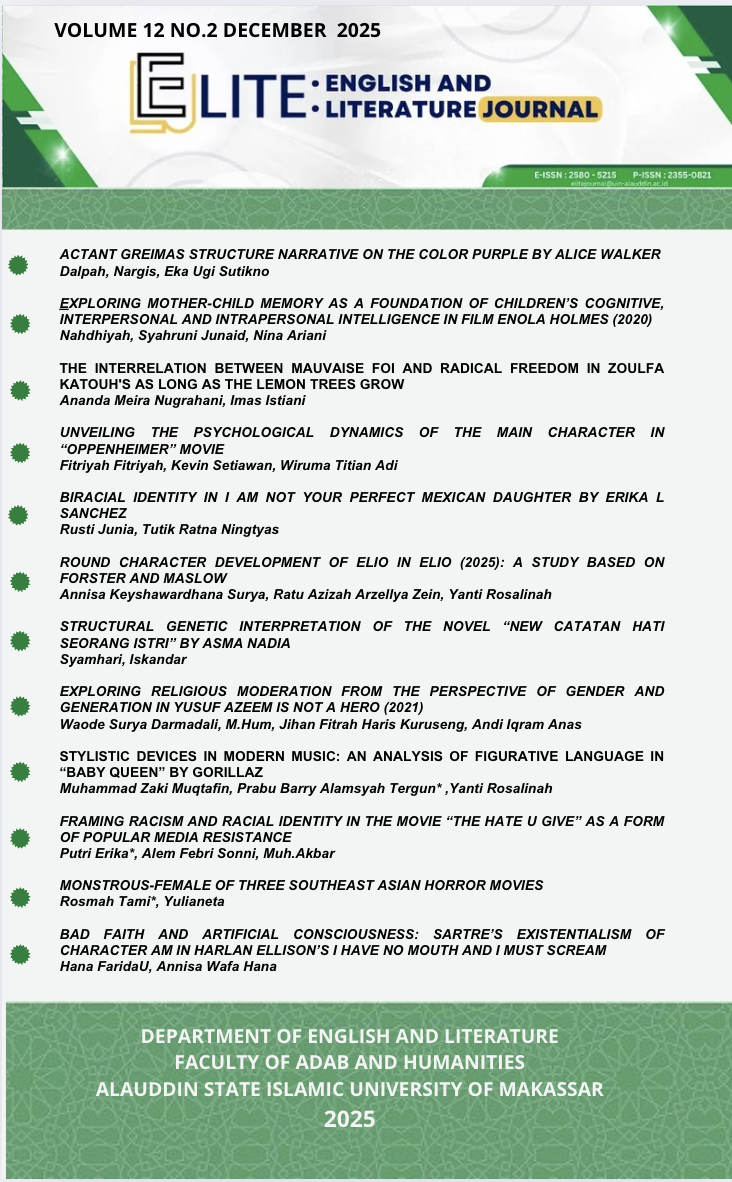
ROUND CHARACTER DEVELOPMENT OF ELIO IN ELIO (2025): A STUDY BASED ON FORSTER AND MASLOW
Kata Kunci:
character development, round character, self-actualization, hierarchy of needsAbstrak
Karya sastra berfungsi sebagai media untuk mengekspresikan pikiran, emosi, dan pengalaman manusia, salah satunya melalui bentuk film. Film Elio (2025) menggambarkan perjalanan psikologis dan emosional tokoh utamanya, Elio, yang mencerminkan proses menuju aktualisasi diri. Penelitian ini bertujuan untuk menganalisis perkembangan karakter Elio sebagai tokoh bulat berdasarkan teori karakterisasi E.M. Forster, serta mengeksplorasi transformasi psikologisnya menggunakan teori hierarki kebutuhan Abraham Maslow. Dengan menggunakan pendekatan psiko-sastra, penelitian ini mengintegrasikan perspektif sastra dan psikologi untuk memahami bagaimana perubahan perilaku dan pola pikir Elio merepresentasikan pemenuhan kebutuhan manusia, mulai dari rasa aman dan penerimaan sosial hingga kesadaran diri dan aktualisasi diri. Hasil penelitian menunjukkan bahwa transformasi Elio mencerminkan ciri-ciri tokoh bulat dan selaras dengan tahapan hierarki kebutuhan Maslow. Penelitian ini menyimpulkan bahwa film Elio menggambarkan bagaimana narasi film dapat menjadi refleksi dari pertumbuhan psikologis manusia dan pencarian jati diri.
Unduhan
Referensi
Ahdiani, U., & Maulana, A. (2023). Abraham Maslow’s hierarchy of human needs building self-actualization reflected in a Broken Home child character. NOTION: Journal of Linguistics, Literature, and Culture, 5(2), 151–168. https://doi.org/10.12928/notion.v5i2.8559
Allen, K., Kern, M. L., Rozek, C. S., Dennis, M., Slavich, G. M., Kern, M. L., Rozek, C. S., Dennis, M., Rozek, C. S., & Mcinerney, D. M. (2021). Belonging : a review of conceptual issues , an integrative framework , and directions for future research ABSTRACT. Australian Journal of Psychology, 73(1), 87–102. https://doi.org/10.1080/00049530.2021.1883409
Azzahra, F., & Asfari, N. A. B. (2024). Pengembangan aktualisasi diri: Kajian pustaka tentang faktor penghambat dan strategi pendukung. Flourishing, 4(2), 84–92.
Bakar, A. A., & Osman, M. M. (2022). HUMAN NEEDS FULFILLMENT : CONTRIBUTING FACTORS. Journal of the Malaysian Institute of Planners, 20(3), 282–294. https://doi.org/https://doi.org/10.21837/pm.v20i22.1145
Bouizegarene, N., Ramstead, M. J. D., Constant, A., Friston, K. J., & Kirmayer, L. J. (2024). Narrative as active inference : an integrative account of cognitive and social functions in adaptation. 1345480(June), 1–19. https://doi.org/10.3389/fpsyg.2024.1345480
Branje, S., Elisabeth L, de M., Spitzer, J., & Becht, A. I. (2021). Dynamics of Identity Development in Adolescence : A Decade in Review. JOURNAL OF RESEARCH ON ADOLESCENCE, 31(4), 908–927. https://doi.org/10.1111/jora.12678
Bunga, A., Fitriane, A., & Nugroho, A. (2022). THE FULFILMENT OF MASLOW ’ S HIERARCHY OF NEEDS ON MAIN CHARACTERS IN “ ENCANTO ” MOVIE : A HUMANISTIC STUDY. ISLLAC : Journal of Intensive Studies on Language, Literature, Art, and Culture Volume, 6(1), 116–127. https://journal2.um.ac.id/index.php/jisllac/article/view/26587/9906
Fischer, R., Karl, J. A., Luczak-roesch, M., Fetvadjiev, V. H., & Grener, A. (2020). Tracing Personality Structure in Narratives : A Computational Bottom-Up Approach to Unpack Writers , Characters , and Personality in Historical Context. August 2019. https://doi.org/10.1002/per.2270
Fitriyah, F., Anindya, F. D., Literature, E., Program, S., Bina, U., & Informatika, S. (2024). Stereotypical Barbie Archetypal Role in Navigating the Storyline of “ Barbie ” ( 2023 ) By Greta Gerwig. 11(2), 158–173. https://doi.org/10.24252/elite.
Forster, E. M. (1927). Aspects of the novel. Edward Arnold.
Forster, E. M. (2005). Aspects of the novel (Penguin Classics ed.). Penguin Books.
Hamzanwadi, U. (2020). Urgensi Teori Hierarki Kebutuhan Maslow Dalam Mengatasi Prokrastinasi Akademik Di Kalangan Mahasiswa. Educatio: Jurnal Ilmu Kependidikan, 15(2), 69–80. https://doi.org/10.29408/edc.v15i2.2714
Huang, W. (2024). An exploration of needs within Maslow’s hierarchy of motivation. Advances in Social Behavior Research, 14, 41–44. https://direct.ewa.pub/journal/asbr/article/view/19284?
Kleemans, M., Eden, A., & Daalmans, S. (2025). Explaining the role of character development in the evaluation of morally ambiguous characters in entertainment media Doi link to publisher : https://doi.org/10.1016/j.poetic.2016.10.003 2017, 16–28.
Kuo, P., & Chung, Y. E. (2019). ScienceDirect Moody microbiome : Challenges and chances. Journal of the Formosan Medical Association, 118(17), S42–S54. https://doi.org/10.1016/j.jfma.2018.09.004
Marcus, L. (2021). E.M. Forster and the Character of “Character.” Cambridge Quarterly, 50(2), 159–172. https://doi.org/10.1093/camqtly/bfab018
Maslow, A. H. (1943). A theory of human motivation. Psychological Review, 50(4), 370–396. https://doi.org/10.1037/h005434
Unduhan
Diterbitkan
Cara Mengutip
Terbitan
Bagian
Lisensi
Hak Cipta (c) 2025 Annisa Keyshawardhana Surya, Ratu Azizah Arzellya Zein, Yanti Rosalinah

Artikel ini berlisensiCreative Commons Attribution-NonCommercial-ShareAlike 4.0 International License.
Once an article was published in the journal, the author(s) are:
granted to the journal right licensed under Creative Commons License Attribution that allows others to share the work with an acknowledgement of the work's authorship.
permitted to publish their work online in third parties as it can lead wider dissemination of the work.
continue to be the copyright owner and allow the journal to publish the article with the CC BY-NC-SA 4.0 license
receiving a DOI (Digital Object Identifier) of the work.