Early hearing detection and hearing conservation training
An occupational health intervention for fishermen
DOI:
https://doi.org/10.24252/sociality.v5i1.61924Keywords:
early detection, fishermen, hearing loss, noise, occupational healthAbstract
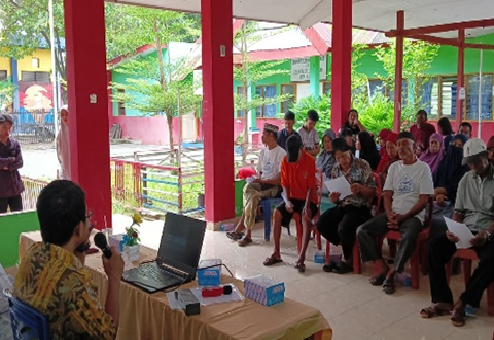
Occupational noise exposure represents a significant health risk for fishing communities, yet community-based preventive interventions for early detection and hearing conservation remain limited, particularly in coastal settings. Fishermen in Kelurahan Untia, Makassar City, are routinely exposed to high noise levels generated by boat engines and maritime work activities, increasing their risk of noise-induced hearing loss. This work aimed to improve fishermen’s occupational health through integrated early hearing detection and hearing conservation training. The intervention involved 50 participants, consisting of fishermen and family members from fishing households, particularly housewives, reflecting a family-based participatory approach. Program activities included education on occupational noise hazards and their impact on hearing health, assessment of noise exposure in fishing work environments, early hearing screening using the whisper test, and practical training on the use of hearing protection devices (earplugs). Program effectiveness was evaluated using a pre-test and post-test design to measure changes in participants’ knowledge regarding noise-related risks and hearing loss prevention. The results demonstrated a significant improvement in knowledge following the intervention, with 70% of participants reaching a high knowledge level compared with predominantly low baseline knowledge. Early hearing screening also identified a small proportion of participants with suspected mild hearing impairment who required further referral. These findings indicate that community-based early detection and hearing conservation training is feasible and effective in improving awareness and preventive behaviors among fishermen, and may contribute to reducing the long-term burden of noise-induced hearing loss and enhancing well-being in coastal communities.
References
Ahmad, I., Pervin, A., & Hossain, I. (2025). Occupational health risks, safety essentials, and safety beliefs among construction workers in Bangladesh. Scientific Reports, 15(1). https://doi.org/10.1038/s41598-025-12621-3
Albizu, E., Gonçalves, C., Lacerda, A., Zeigelboim, B., & Marques, J. (2020). Noise exposure and effects on hearing in Brazilian fishermen. Work, 65(4), 881–889. https://doi.org/10.3233/WOR-203139
Bochimoto, H., Ishimaru, T., Nakano, A., Hasegawa, K., Kimura, E., Tajima, S., & Nemoto, H. (2023). Association between workplace social support and use of health-promoting wearable devices: A prospective cohort study of Japanese employees. Journal of UOEH, 45(2), 95–103. https://doi.org/10.7888/juoeh.45.95
Chen, K., Su, S., & Chen, K. (2020). An overview of occupational noise-induced hearing loss among workers: Epidemiology, pathogenesis, and preventive measures. Environmental Health and Preventive Medicine, 25(1). https://doi.org/10.1186/s12199-020-00906-0
Edalati, S., Omidvar, N., Takian, A., Rasam, F., Ghodsi, D., & Majdzadeh, R. (2023). Participatory evaluation of municipal obesity prevention clubs in Tehran city: Strengths, challenges, and future direction. Frontiers in Public Health, 11. https://doi.org/10.3389/fpubh.2023.1055210
Elshaer, N., Meleis, D., & Mohamed, A. (2023). Prevalence and correlates of occupational noise-induced hearing loss among workers in the steel industry. Journal of the Egyptian Public Health Association, 98(1). https://doi.org/10.1186/s42506-023-00135-7
Ernawati, M. (2021). Literature review: Risk factors affecting hearing loss among fishermen in Indonesia. Journal of Drug Delivery and Therapeutics, 11(3), 153–159. https://doi.org/10.22270/jddt.v11i3.4780
Etowa, J., Hyman, I., & Unachukwu, U. (2025). Use of a peer equity navigator intervention to increase access to COVID-19 vaccination among African, Caribbean and Black communities in Canada. International Journal of Environmental Research and Public Health, 22(8), 1195. https://doi.org/10.3390/ijerph22081195
Fatah, H., Yasin, S., Muzaini, K., & Abdullah, M. (2025). Facilitators and barriers to implementing hearing conservation programmes in industrial workplaces: A systematic review. Occupational and Environmental Medicine. https://doi.org/10.1136/oemed-2025-110134
Gong, W., Zhao, L., Li, L., Morata, T., Qiu, W., Feng, H., & Zhu, B. (2021). Evaluating the effectiveness of earplugs in preventing noise-induced hearing loss in an auto parts factory in China. International Journal of Environmental Research and Public Health, 18(13), 7190. https://doi.org/10.3390/ijerph18137190
Gong, X., Yi, M., Jiang, C., Xiong, Q., Xu, B., Weng, F., & Zhang, Q. (2025). Global burden and trends of occupational noise-induced hearing loss (1990–2021) and projection to 2040. Frontiers in Public Health, 13. https://doi.org/10.3389/fpubh.2025.1682413
Magoha, L., Nyanza, E., Asori, M., & Thomas, D. (2024). Informal welders’ occupational safety and environmental health risks in northwestern Tanzania. PLOS Global Public Health, 4(2), e0002923. https://doi.org/10.1371/journal.pgph.0002923
Munni, M., Karim, M., Haque, M., Khan, S., Khan, M., & Hossain, I. (2024). Awareness, safety practices and associated factors among e-waste recycling workers in Bangladesh. Environmental Health Insights, 18. https://doi.org/10.1177/11786302241271555
Ock, M., Pyo, J., Kim, O., Chae, C., Ye, B., Kim, S., & Lee, J. (2020). Experience and awareness of health managers, administrators, and workers on a hearing conservation program in Korea: A qualitative study. International Journal of Environmental Research and Public Health, 17(7), 2302. https://doi.org/10.3390/ijerph17072302
Rogers, H., Hernando, S., Núñez-Fernández, S., Sánchez, Á., Martos, C., Moreno, M., & Grandes, G. (2021). Barriers and facilitators in the implementation of an evidence-based health promotion intervention in a primary care setting: A qualitative study. Journal of Health Organization and Management, 35(9), 349–367. https://doi.org/10.1108/JHOM-12-2020-0512
Singhal, D., Lyngdoh, T., & Prabhakaran, P. (2021). Knowledge, attitude and practice study of health risks among e-waste recyclers in Delhi. Journal of Health and Pollution, 11(29). https://doi.org/10.5696/2156-9614-11.29.210306
Tikka, C., Verbeek, J., Kateman, E., Morata, T., Dreschler, W., & Ferrite, S. (2020). Cochrane method for systematic review and meta-analysis of interventions to prevent occupational noise-induced hearing loss – abridged. CODAS, 32(2). https://doi.org/10.1590/2317-1782/20192019127
Turin, T., Chowdhury, N., Haque, S., Rumana, N., Rahman, N., & Lasker, M. (2021). Meaningful and deep community engagement efforts for pragmatic research and beyond: Engaging with an immigrant/racialised community on equitable access to care. BMJ Global Health, 6(8), e006370. https://doi.org/10.1136/bmjgh-2021-006370
Yadav, O. P., Shan, D., Sarkar, A., & Moro, L. (2023). Occupational noise exposure at sea: A socio-legal study on fish harvesters’ perceptions in Newfoundland and Labrador, Canada. Frontiers in Public Health, 11, 1092350. https://doi.org/10.3389/fpubh.2023.1092350
Zhou, J., Shi, Z., Zhou, L., Hu, Y., & Zhang, M. (2020). Occupational noise-induced hearing loss in China: A systematic review and meta-analysis. BMJ Open, 10(9), e039576. https://doi.org/10.1136/bmjopen-2020-039576
Downloads
Published
How to Cite
Issue
Section
License
Copyright (c) 2025 Iwan Suryadi, Nurlaila Fitriani

This work is licensed under a Creative Commons Attribution-NonCommercial-ShareAlike 4.0 International License.